


E-waste Hit a Record 62 Billion kg in 2022, and Repair Is the Front Line
ServiceMag Staff
ServiceMag editorial staff covering the appliance and HVAC trade.
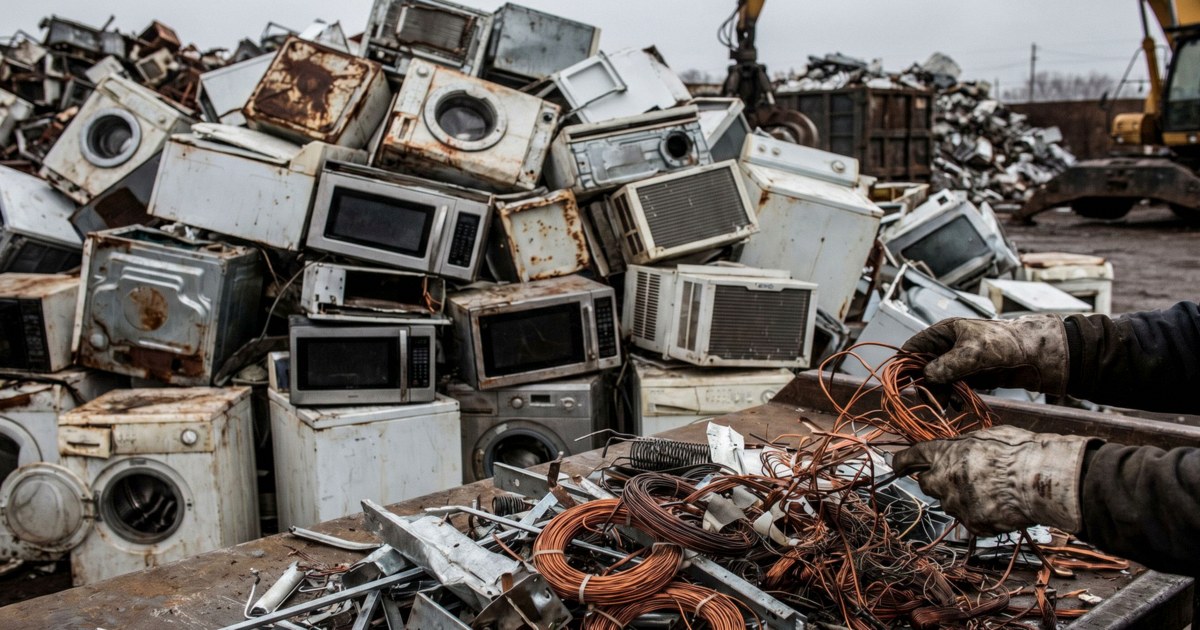
The world generated 62 billion kg of electronic waste in 2022, a record, and only 22.3% of it was documented as properly collected and recycled. Those figures come from the Global E-waste Monitor 2024, produced by the UN's International Telecommunication Union and UNITAR with lead author Kees Baldé. It's an institutional report rather than a peer-reviewed study, but it's the closest thing the world has to an official e-waste scoreboard, and the 2024 edition makes grim reading.
Generation is up 82% since 2010 and climbing by about 2.6 billion kg a year. Documented recycling isn't keeping pace. Not even close: the report finds e-waste generation rising five times faster than formal recycling. By 2030 the authors project 82 billion kg of annual e-waste, with the documented recycling rate slipping to around 20%.
The money left on the table is real too. Metals embedded in 2022's e-waste were worth an estimated $91 billion, including $19 billion in copper and $15 billion in gold, and $62 billion of recoverable material went unaccounted for.
Where appliances sit in the e-waste stream
The category data holds a sliver of encouragement for the appliance trade. Collection and recycling rates run highest for heavy, bulky gear: large equipment and temperature exchange equipment, the bucket that holds refrigerators, freezers, air conditioners, and heat pumps. Small gadgets are the problem children. Small equipment was the largest stream at 20.4 billion kg with a documented recycling rate around 12%. (Nobody ships a toaster to a recycler. A dead fridge at least gets hauled somewhere.)
Temperature exchange equipment carries its own stakes. The report counts roughly 500 million kg of copper sitting in the compressors and cables of that category alone, and it warns that unmanaged recycling of these units damages the climate and the ozone layer when refrigerant vents during informal processing. Every EPA 608 card in the field is, by the report's framing, a small piece of climate infrastructure.
Geography skews the picture as well. Europe documents collection and recycling at 42.8%, Africa sits below 1%, and Asia generates about half the global total.


Repair as deferred waste
Recycling is the report's subject, but repair is the quieter lever sitting upstream of it. A recycled refrigerator recovers some copper and steel. A repaired refrigerator keeps the whole machine in service, embedded materials, manufacturing energy, refrigerant charge and all. Every completed service call is waste deferred, which puts working techs on the practical front line of a problem usually discussed in Geneva conference rooms.
That framing has teeth in the sales conversation. When a customer is on the fence, honest repair-versus-replace math usually settles it, but the waste angle moves a growing slice of customers who care where their old unit ends up. Durability trends aren't helping; research showing washing machine lifespans dropped 45% suggests the replacement treadmill is speeding up. And work on IoT sensors extending appliance lifespan points the same direction the Monitor does: keeping machines alive is the cheapest intervention on the board.
The report's own arithmetic backs that up. Its authors project that raising global collection and recycling to 60% by 2030 would generate benefits exceeding costs by $38 billion.
Nobody in a service van fixes a 62-billion-kg problem alone. But the trade's daily output, machines that keep running instead of hitting the curb, is the one line on the e-waste ledger that never appears, because it never became waste.
Source
Baldé, C.P., Kuehr, R., et al. (2024). "The Global E-waste Monitor 2024." International Telecommunication Union (ITU) and United Nations Institute for Training and Research (UNITAR), Geneva/Bonn. https://ewastemonitor.info/the-global-e-waste-monitor-2024/