


Water Heater Not Heating: Complete Diagnostic Guide for Gas, Electric, and Heat Pump Units

Terry Okafor
Master refrigeration tech and NATE-certified instructor who moonlights as the magazine's advice columnist. His 'Ask Big Terry' mailbag has been settling shop disputes and diagnosing mystery leaks since 2011.
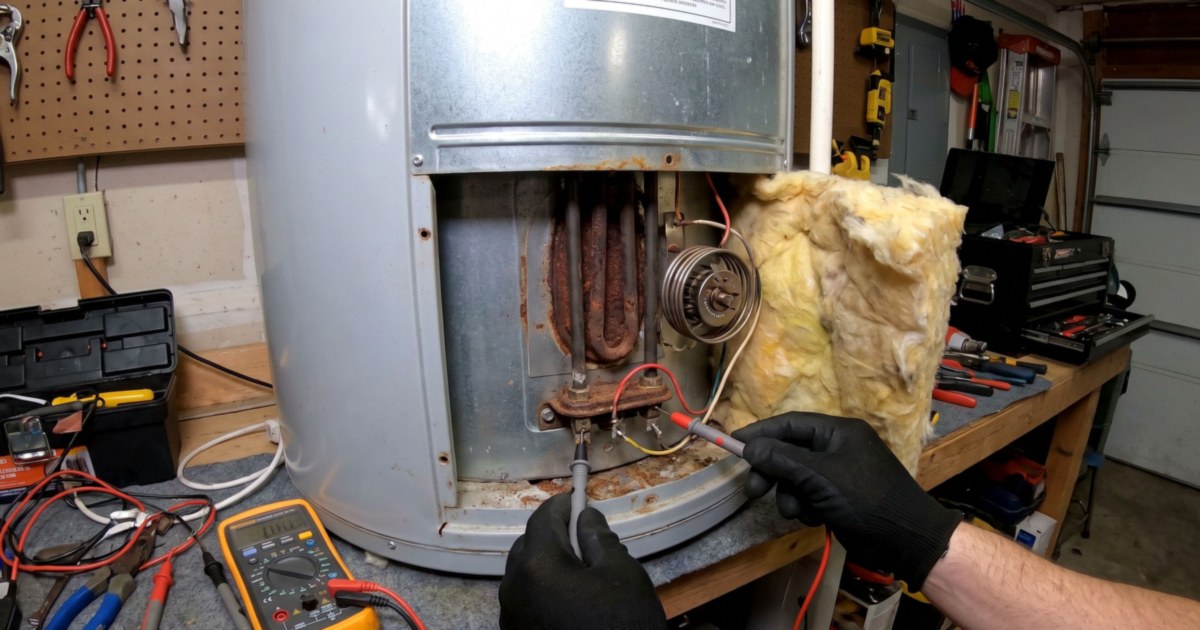
A water heater not heating is three different diagnostic jobs wearing the same complaint, and the first useful question is which machine you are standing in front of. An electric tank, a standing-pilot gas tank, a power-vented gas tank and a heat pump hybrid fail in almost completely different ways, and the only thing they share is that most no-hot-water calls end at a part under $30.
Before any of it, a temperature note that matters more than people think. The scald table Rheem prints in its residential manuals, credited to the Shriners Burn Institute, shows water at 120°F taking more than 5 minutes to produce a serious burn, while 140°F does it in under 5 seconds. Rheem's own DANGER note says households with small children, disabled or elderly occupants may need a setting of 120°F or lower. If the complaint is "not hot enough" and the dial reads 120°F, the heater may be working exactly as designed.
Electric Tanks: Breaker, Red Button, Elements
Rheem's electric residential troubleshooting chart lists the boring causes first. They are boring because they are right: a blown fuse or tripped breaker, the electric supply switched off, a thermostat set too low, an open hot water faucet somewhere in the house, improper wiring, and the manual reset limit.
That last one is the reset everybody asks about. Rheem describes an ECO, a temperature limiting control mounted above the upper heating element in contact with the tank surface. It breaks the power circuit to the element if water temperature gets excessively high. Once it opens, it has to be reset by hand. The procedure in the manual is to turn off power to the heater, remove the control cover and insulation, press the red RESET button, and put the insulation and cover back before restoring power.
Read the caution that follows it. That is the part that gets skipped. Rheem states that the cause of the high-temperature condition must be investigated by a qualified service technician and corrected before the heater goes back in service. A reset button that trips twice is not a reset button problem. Usually it is a grounded element or a thermostat stuck closed. Both will keep cooking the tank.
Element testing is arithmetic, not guesswork. Resistance is the square of the voltage divided by the wattage. A 4500-watt element on 240 volts should measure about 12.8 ohms, a 5500-watt element about 10.5 ohms, and a 3500-watt element about 16.5 ohms. Open circuit means a burned-out element. Then check each terminal to the tank shell. Any continuity to ground means the element has failed to the water side, and that is the failure that trips the limit control over and over.
The symptom pattern tells you which element before you open anything. Most residential electric tanks are wired non-simultaneous, with the upper thermostat holding priority. A dead upper element leaves you with almost no hot water at all. A dead lower element gives you a short burst of hot, then cold, because only the top third of the tank is being heated.
Parts on this side are cheap. PlumbersStock lists the Camco 02343 screw-in element, rated 4500 watts at 240 volts and 3500 watts at 208 volts, at $8.51, and notes it needs a minimum tank diameter of 15 inches. HD Supply lists the Camco 07863 Apcom-style upper thermostat, factory preset at 120°F and serving as the high limit control, at $26.99, described as compatible with State, A.O. Smith and other brands. Confirm either part against your model number before ordering, since element flange style and thermostat mounting vary.
Standing-Pilot Gas: The Thermocouple Does Most of the Failing
If you smell gas, stop reading and get out.
Everything below assumes a heater that is not leaking gas.
A pilot that dies the moment you release the control knob is the signature thermocouple failure. The thermocouple sits in the pilot flame and generates a few tens of millivolts. That tiny voltage energizes an electromagnet inside the gas control, and the magnet holds the pilot valve open. Output drops. The magnet lets go. The pilot dies.
Heating Help's thermocouple testing procedure gives a worked example of 30 millivolts open circuit and 15 millivolts closed circuit, and says open-circuit readings must be above 17 to 18 millivolts. That same reference makes a point worth repeating to anyone who bills by the hour. Roughly 85% of the time the thermocouple is the problem. Plenty of shops simply replace it and clean the pilot rather than meter it first.
Flame position matters as much as the part. Rheem's service bulletin on thermocouple replacement specifies positioning the tip so the pilot flame envelopes the top 3/8 to 1/2 inch of it. Tighten the connection at the gas control no more than a quarter turn beyond hand tight. Overtightening is the most common self-inflicted failure on this repair. The bulletin also has you soap-test the main burner and pilot supply tubes at the valve afterward. Vacuum the combustion chamber while the assembly is out, and clean the burner and orifice.
On sealed-combustion designs, the heater draws combustion air through a screened opening at the base. Lint, pet hair and dryer fluff will close that screen. Rheem's standing-pilot maintenance bulletin says plainly that the flow of air to the water heater must not be obstructed for proper burner operation. A heater tucked into a laundry closet next to a dryer is the case to look at first.
When the pilot holds but the main burner will not fire on a call for heat, the gas control valve is the suspect. Black Hawk Supply lists Rheem SP20164, a Gas Control Valve (Thermostat) for natural gas, at $231.81. That price is the whole repair-or-replace conversation in one number, and we get into the general version of it in our gas valve troubleshooting and safety guide.
Power-Vented and Electronic Ignition Gas: Read the Code First
Newer gas heaters replaced the standing pilot with a hot-surface or spark igniter, a blower, pressure switches and a flame rectification circuit. They will tell you what went wrong if you let them.
From Rheem's use and care manual for its electronic-ignition gas line: A001 is an ignition lockout after nine consecutive failed ignition attempts, which disables the heater. A002 means the flame was lost three times during one heat cycle. A003 is the intake pressure switch reading open with the blower running, A007 is the exhaust flue pressure switch open during heating, and A004 through A006 are proof-of-airflow switch faults during heating, pre-purge and post-purge respectively. A016 is the energy cutout switch open. A017 fires when flue gas temperature exceeds 155°F, and A018 and A019 are an open or shorted flue temperature sensor.
The manual's plain-language troubleshooting table adds two causes that have nothing to do with parts. For a main burner that will not stay lit, it points at burner flame not contacting the sensor rod, which is a flame rectification issue, and at the unit or electrical supply line not being properly grounded. Poor grounding kills flame sense on every brand. It is free to check. Chasing a "bad board" on a heater with a loose ground screw is a classic wasted afternoon; our combustion analysis guide covers what a proper flame looks like when you get there.
Heat Pump Hybrids: Usually a Mode, Not a Failure
Most heat pump water heater no-hot-water calls are not a failure at all. They are a mode, a filter, or a condensate line.
Rheem's Gen V hybrid manual lists five modes. Energy Saver is the factory default and mixes compressor and element operation. Heat Pump mode locks out the elements entirely and recovers very slowly. That is exactly the complaint a homeowner reports as "it ran out and never came back." High Demand runs the compressor and an element together. Electric Only runs on resistance heat alone, and the manual says to use it only during compressor maintenance. Vacation holds the tank at about 82°F for a set period between two and 28 days, or indefinitely on Hold, and a customer returning from a trip to a cold shower has usually just forgotten to take it off.
Location drives performance more than any component. Rheem specifies a room larger than 700 cubic feet, roughly a 7-by-10-by-10-foot space, and notes the unit will operate in rooms down to 450 cubic feet with reduced efficiency and reduced performance output. It also asks that ambient temperatures not exceed 145°F, and wants 6 inches of clearance above the unit.
The alarm codes are specific enough to work from directly. T131 is a routine clean-filter reminder, and the manual's fix is to set the unit to Electric or Off, wash the filter in mild detergent, dry it and reinstall. A108 means the condensate line is blocked and the heater has defaulted to the elements, which shows up on the utility bill long before it shows up as cold water. A125 and A126 flag a lower or upper element error or a relay stuck closed, A102 is an ambient temperature sensor failure, and A200 means the ECO has tripped and the heater is disabled. T132 is the honest one: the water heater cannot satisfy demand, and the manual's own list of causes ends with the unit possibly being sized too small. Our heat pump diagnostics guide covers the refrigerant-side checks if the compressor really is the problem.


Lukewarm Is a Different Complaint
Sediment gets blamed for everything. Rheem's own maintenance bulletin is more measured about it than the internet is. The bulletin describes the tank acting as a settling basin for suspended solids, says deposits should not be allowed to accumulate because they affect service life, and suggests draining a few quarts monthly. On the noise, it says a rumbling or pounding sound can occur, that there is no danger involved, and that efficiency is not seriously affected, but the noise can be annoying. Worth knowing before you sell a flush as an efficiency fix.
A dip tube is a better explanation for genuinely lukewarm water. The tube carries incoming cold to the bottom of the tank. When it cracks or breaks off short, cold enters near the top and leaves straight through the hot outlet. Nothing is wrong with the heat source.
While you are there, pull the anode rod. Rheem's bulletin says to inspect it annually and replace it when more than 6 inches of core wire is exposed at either end. Nobody ever looks. That is how a seven-year-old tank becomes a leaking tank.
What the Repairs Cost
On an electric tank, test both elements to ground before you replace either one. A grounded element will trip the high-limit control again within a day, and the customer will remember that you were there when it happened. It takes 30 seconds with a meter and it is the difference between a repair and a callback.
Where the Repair Stops Making Sense
Run the math against age and the numbers get uncomfortable fast. A $232 gas control valve plus labor on a 12-year-old atmospheric tank is most of the way to a new heater, one with a fresh warranty and better first-hour delivery. The anode in that old tank has been gone for years.
Elements and thermocouples are different. Those are cheap at any age. Replacing one on an eight-year-old heater is money well spent. The line I use with customers is the tank itself: if the shell is sound and the anode has been maintained, fix the controls. If the tank is weeping anywhere, nothing you bolt to it will matter. Delaying that call has its own price, which we broke down in the real cost of delaying appliance repairs.
Sources
Rheem Manufacturing. "Electric Residential Water Heaters with e-Control, Use and Care Manual, AP21980 Rev 02." (ECO reset procedure, troubleshooting chart, scald table.) https://media.rheem.com/media/uploads/iat/sites/36/2022/09/AP21980-Rev-02-Electric-Residential-WH-with-e-control-HIGH-TIER.pdf
Rheem Manufacturing. "Use and Care Manual, AP21831 Rev 2." (Electronic-ignition gas alarm codes and troubleshooting tips.) https://media.rheem.com/blobazrheem/wp-content/uploads/sites/36/2023/12/AP21831-Rev-2-SHEG-TriBrand-UC.pdf
Rheem Manufacturing. "Electric Residential Hybrid Water Heater, Use and Care Manual, AP23657 Rev 01." (Operating modes, room size, alarm codes.) https://media.rheem.com/blobazrheem/wp-content/uploads/sites/36/2024/07/AP23657-Rev-01-Manual-HPWH-GEN-V-UNIVERSAL-CONNECT-ENGLISH_HALF-SIZE-3.pdf
Rheem Technical Service Department. "Technical Service Bulletin 1410: How to Replace a Thermocouple, Residential Standing Pilot Gas." https://www.rheem.com/whtechbulletins/
Rheem Technical Service Department. "Technical Service Bulletin 1401: Standing Pilot Gas Water Heater Maintenance." https://www.rheem.com/whtechbulletins/
Heating Help. "Thermocouple Testing Procedure." Systems Help Center. https://heatinghelp.com/systems-help-center/thermocouple-testing-procedure/
Black Hawk Supply. "Rheem SP20164 Gas Control Valve (Thermostat), Natural Gas." https://blackhawksupply.com/products/mpk-sp20164-rheem-water-heater
PlumbersStock. "Camco 02343 4500W Screw-In Water Heater Element." https://www.plumbersstock.com/camco-02343-4500w-screw-in-water-heater-element.html
HD Supply. "Camco Apcom Style Upper Thermostat for Electric Tank Water Heater (07863)." https://hdsupplysolutions.com/p/camco-apcom-style-upper-thermostat-for-electric-tank-water-heater-p245643
ABR Wholesalers. "SP20064 Rheem Water Heater Thermocouple Replacement Kit." https://abrwholesalers.com/sp20064-rheem-water-heater-thermocouple-replacement-kit-fvir57176
How do I reset my water heater?▾
On an electric tank, the reset is the red button on the high-temperature limiting control, which Rheem locates above the upper heating element against the tank surface. Turn off power at the breaker, remove the access cover and insulation, press the button, then reinstall everything before restoring power. Rheem is explicit that the cause of the high-temperature condition has to be found and corrected before the heater goes back in service.
Why does my water heater pilot light keep going out?▾
Usually the thermocouple. It generates a small voltage from the pilot flame that holds the gas valve's magnet open, and when that output falls the valve drops out. Heating Help's testing procedure gives a normal open-circuit example of 30 millivolts and says readings must stay above 17 to 18 millivolts. Check flame position too: Rheem's bulletin wants the pilot flame enveloping the top 3/8 to 1/2 inch of the thermocouple tip.
How much does it cost to replace a water heater element or thermocouple?▾
The parts are cheap. A Camco 4500-watt, 240-volt screw-in element lists at $8.51 and a Camco Apcom-style upper thermostat with the high-limit control at $26.99, with a Rheem thermocouple kit in the same range. Labor carries the bill, typically landing the finished job between $150 and $300. The expensive gas part is the control valve: Rheem's natural gas unit lists at $231.81 before any labor.
Why is my hot water lukewarm instead of hot?▾
Lukewarm points at mixing rather than a dead heat source. A failed lower element on an electric tank heats only the top of the tank. A cracked or broken dip tube delivers incoming cold near the hot outlet instead of the bottom. A failed mixing valve or a worn single-lever faucet can let cold cross into the hot line, and that version shows up at one fixture while the rest of the house is fine.
Need a repair professional?
Get free quotes from verified technicians in your area.
Find a Pro Near You